
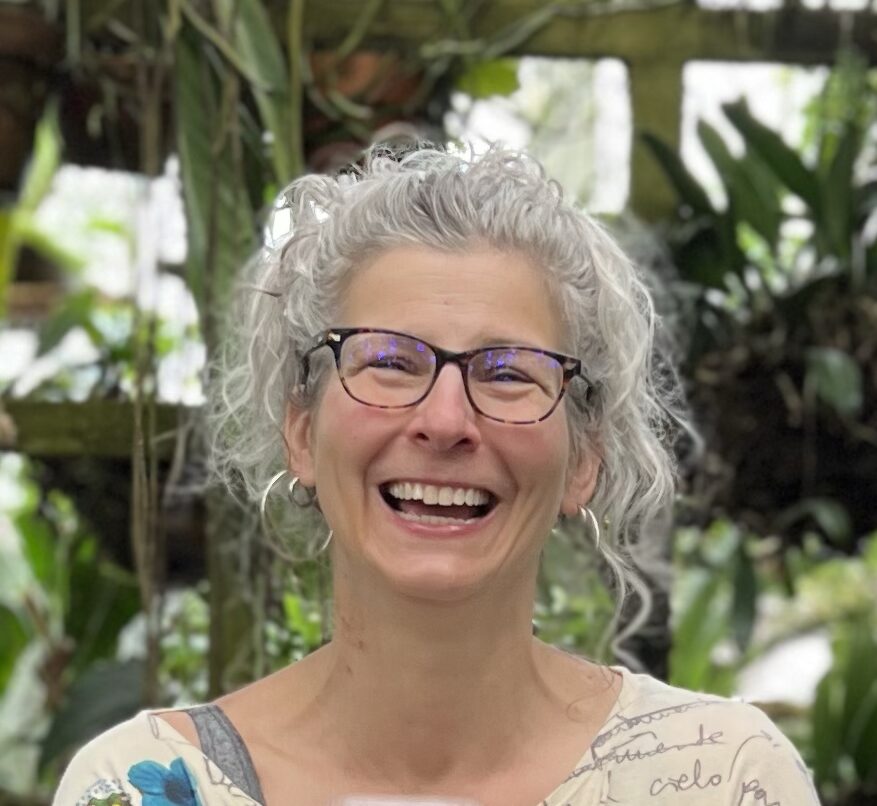
 Interview by Audrey Xu, SFWA MYEEP Intern
I noticed a lot of your works are influenced by feminism and female empowerment. What is your inspiration behind that?
I was raised by a grandmother who was a quilter. She was the Reeve of her town, which was cool for that era. My mother was an illustrator and also sewed. I come from a family of women who were independent and powerful, but were also into domestic labor—like sewing and cooking—and I modeled my life after that. I’m an independent woman; I love cooking and sewing, but I sew in a very different way. I sew artwork. Less functional, but it’s for communicating a message. I’m a graphic designer by trade, so communicating a message is really important to me. I think in this day and age where every time we move forward, we get kicked back, it’s really important to be political with your work.
You use multimedia as a medium quite often in your pieces. How did you discover your love for the medium?
That’s a really long story! I wanted to be a fine artist but my parents wouldn’t let me. They suggested I pursue a career in graphic design, so that’s what I did, but then I always missed art. So, I always did the art side of things on my own. I was a graphic designer in Canada, and I went to OCADU. Back in the day, graphic design was considered a trade, and it wasn’t really part of the university system yet. I learned the skill and I worked as a graphic designer for about fifteen years and taught part-time in the evenings. Later on, I decided I wanted to make the shift to teaching full-time, and I had to get my master’s in order to do that. So, in my mid-thirties, I went to get my master’s, which was very challenging. It was difficult to go back to school in your mid-thirties after not having a university underpinning. My thesis looked at how to take fine art and craft and work it into graphic design. Because I worked in a corporate environment for so long, it was really hard for me to not separate the two kinds of creative endeavors. I struggled, but finding that technique of sewing paper came out of all the experimentation and exploration I did during my master’s. A lot of failed explorations led to that technique, which is my own!
What thoughts do you hope to provoke with your work?
I collect vintage women’s magazines. Back in the day, they had vintage etiquette books that described how to behave as a woman. I love reading those because it’s actually kind of horrifying, as well as women’s catalogs, because you can see the corsets they wear and the hardships they had to go through to be womanly and it’s mindboggling. By using those and bringing them into the public realm, I want people to really think about media and how we are told to behave, and what we should look like. For example, right now, plastic surgery is huge, and that’s the same as wearing a corset to me. It’s just media telling you how you should look, how you should behave, and encouraging people to alter themselves to be more beautiful. I like the aspect of showing them that nothing has really changed, and as ludicrous as it sounds back in the 50s, we’re just doing it in different ways now. I hope people get that from my work, and I hope people see that things need to change.
Most valuable piece of advice for artists trying to leave a message?
To persevere. I don’t sell a lot of my work. My work challenges you. You have to engage with it, and you have to critically think about it. Some of the words I use are a little jarring. But I keep going—I just keep going and I don’t care if it sells or not. I feel the need to do it and put it out in the world. I’ve had people say that I should just do what will sell, and to me, that is not fulfilling. So, just do what fulfills you.